
Preface: I conceived the following short story back in 2021, during one of my Philadelphia writer’s Meetup groups. While I don’t remember what the exact writing prompt was, it ignited my creative brain and inspired me to write a short story about an ugly, scarred woman who invites a young artist to her Paris apartment to draw a sketch of her, taking place some time during the 19th century.
I read my story aloud to my friends, using a soft tone to emphasize how vulnerable and scared the woman felt about having an artist sketched her, and my friends absolutely loved what I wrote. I tried to expand upon my story but realized that I didn’t know anything about the time period, and I didn’t want to do any research at the time because I found everything too overwhelming.
So I stuck the story in a notebook, completely forgot about as the years passed, then randomly came across it when I was looking through some of my old notebooks and journals. I re-read what I wrote and got excited about where the story could go, but made two important changes: 1.) I made the artist the main character as opposed to the woman, and 2.) I wrote the story from the third-person point of view using a narrator instead of from the first-person point of view, from inside the woman’s head.
After doing that, I was able to expand upon the story into a three-part, short story series, which I’m finally happy to present to you Part I below! So enjoy, and stay tuned for the remaining parts.
Much love,
Kendall
Synopsis: A young artist receives a letter from the friend of a former client, and agrees to meet his correspondent for dinner to discuss a job opportunity about painting the portrait of a mysterious, ‘ugly’ woman.
The Young Artist Who Painted the Portrait of the Ugly, Scarred Woman – Part I
by Kendall Beaver
Paris, 1857
The sun had just set for the day, disappearing behind Paris: a Paris where the Eiffel Tower has yet to be built, a sprawling and crowded city filled with medieval cathedrals and mismatched flats, yet undergoing significant renovation to become a more modernized and organized city–that type of Paris. While the sky had become a dark blue sea, Paris herself was lit up like it was daytime thanks to the many lamplighters who walked the streets with their ladders, stopping and climbing to top of gas-jet lamp posts and igniting bright flames.
The brightest and liveliest place to be tonight is in the 6th arrondissement, an area filled with many upscale restaurants, shops, and cafés. The masses moved along the main Boulevard Saint-Germain, Cabriolet carriages moved around or pushed people aside as they taxied rich and affluent Parisiennes, and immigrant peddlers roamed the boulevard carrying large packs on their back, trying to sell various items to everyone these came across, but were either ignored, pushed aside, or yelled at.
A young, handsome man walked down the boulevard wearing a black dinner suit, a clean, white dress shirt with a matching bow tie, and a top hat. He rounded the corner of a sidewalk café and stepped onto Rue de la Chrétien-Savinne, a smaller and less crowded street, but one filled with upscale shops and restaurants. The young man’s name is Adémir Toussaint, someone who just twenty-three-year-old man, and someone who had a glimmer of cockiness and naïveté in his eyes.
Then young Adémir saw a young, beautiful woman walk underneath a lamp post alongside an older woman who appeared to be her mother, and his eyes widened and heart stop beating for a moment, for Adémir believed that he was staring at one of the most beautiful women he’s ever seen in his life. She had a cute, innocent face, pale skin, long brown curls, and wore a lavender dress that had wiring underneath to give her a bell-shaped figure, making her waist appear tiny.
Adémir, being a professional portrait painter, wanted nothing more than to paint her portrait and to show her absolute and stunning beauty to the entire world, but he most especially wanted to draw her nude in his sketchbook and truly capture all of her beauty. The young woman noticed Adémir’s gaze and they locked eyes for a moment—long enough for them both to realize that they have same amber-colored irises—then she blushed and quickly looked away.
As they passed each other, Adémir tipped his hat and said in his deep, charming accent, “Madame. Demoiselle.” The older woman paid him no attention, but the young woman glanced back at him beaming with a smile, which caused Adémir to grin widely. He slowly turned his head around as he watched her walk away, hoping and praying that he would run into her again, for he believed that such encounters were always possible in Paris.
Adémir continued down the cobblestone street and arrived at a white building on the corner of the street, which had a circular black sign hanging above its black-painted, wooden door that read “Restaurant du Feuchère.” Adémir walked up the front steps, pulled open the front door, then stepped inside and immediately heard laughter and chatter, mixed with the din of knives and forks clinking against plates, followed by strong aromas of tobacco, various spices, and savory flavors that flooded into his nose. “Mmm…” he moaned as he drew in a deep breath, feeling rejuvenation and ecstasy mixed together.
The tall dining hall before him was filled with about two dozen circular tables covered in snow-white linens. Extravagantly-dressed Parisiennes sat at the tables, surrounding many plates of food and pints of wine, where men wore dinner tuxedos and women showed off their big, colorful evening gowns, adorned with jewelry and wide feathered hats. Large, gilded mirrors along the walls reflected light from the bronze chandeliers, giving off a warm and bright sensation to the entire restaurant.
Adémir walked towards the maître d’s podium, where a short and stout man in a black tailcoat was standing.
“Good evening, Monsieur,” he said in his jolly voice, nodding a bow to Adémir.
“Evening,” Adémir nodded back.
“I am Monsieur Alphonse, master of the house. I assume that you are dining in, Monsieur.”
“Why, yes, Monsieur Alphonse. I’ve come to dine with a companion, actually, someone whom I’m meeting for the first time—a Monsieur Eugène de Beauvau.”
“Ahhh, Monsieur Eugène Domergaue, comte de Beauvau,” he said, explaining his full noble title.
“Oh, so you know Monsieur de Beauvau?”
“Why, of course. Not only is he a State Councillor, but he is one of our most frequent patrons.”
“Ah. Yes. Well, I need to acquire a table for Monsieur de Beauvau and I.”
“Oh, Monsieur, that is not necessary, for Monsieur de Beauvau has already arrived and acquired a table for himself and his companion, whom you appear to be.”
“He has?!” Adémir’s eyes bugged out. “Why, I arrived here early to make an impression on him, but it is he who has certainly made the impression on me,” Adémir chuckled, shaking his head.
“Fret not, Monsieur, he has not been here that long, only just a few minutes. But Monsieur de Beauvau did tell me that a young portrait painter will be joining him tonight, a Monsieur Adémir Toussaint, whom certainly you must be.”
“That I am,” Adémir nodded.
Monsieur Alphonse grimaced as he thought something over, then asked, intriguingly, “Monsieur…you say this is your first time meeting Monsieur de Beauvau, so I am curious to know how you two become acquainted, if you don’t mind me asking?”
“Ah, you are quite the keen observer, monsieur Alphonse. Well you see, I received a letter from Monsieur de Beauvau last week, who informed me that he had been referred to me by a previous client of mine, a Monsieur Édouard de Barthélemy—”
“Ahhh, Édouard-Hughes Marie, duc de Barthélemy, another State Councillor and frequent patron here.”
“Yes. Well, it was about three months ago when I completed his portrait; then Monsieur de Barthelemy and his wife invited Monsieur de Beauvau and his wife Madame Marguerite de Beauvau over for dinner, whom saw my portrait and took a liking to it, commenting with how real it looked. Some time had passed, then Monsieur de Beauvau wrote to me, stating that he had a job opportunity that he wanted to discuss with me over dinner, and so here I am.”
“Ahhh, so it seems that Monsieur de Beauvau wants you to paint his portrait.”
“Quite possibly… That is what I’m here to find out.”
“Well, it’s a shame that his wife has been away. We certainly miss her presence.”
Ademir peered his eyes, finding that intriguing. “Monsieur de Beauvau did not mention anything about his wife being away… Where has she gone to?”
“To Marseille, to take care of her sick aunt. She has been away for the past month—no, perhaps two—and ever since she left, Monsieur de Beauvau has not seemed like himself.”
“Hm…what a shame.”
“Well. We mustn’t keep Monsieur de Beauvau waiting any longer.”
“No. No, we mustn’t,” Adémir nodded along.
Then Monsieur Alphonse led the way and Adémir followed him into the main dining hall. As they passed by tables, Monsieur Alphonse nodded at the guests and pointed to a group of wives at one table, miming for them to wipe their entire face, indicating that they’re messy eaters, causing the entire table to erupt and howl with laughter.
Meanwhile, Adémir was looking towards the back where he saw garçons, each wearing a black vest and white apron, patiently awaiting their tables. Then he noticed a hallway in the back-left corner with a sign above it that read Cabinets Particuliers, and he knew that this is where the private dining rooms were located and where wealthy, married men were most likely dining with someone who was not their wife. Then he thought about bringing a future lover here someday to indulge in a first course of pleasure before going to a hotel.
Adémir watched Monsieur Alphonse point and snap his fingers at two garçons standing nearby to come meet him at a table where a small man was sitting by himself, and who Adémir assumed to be his companion. He appeared to be in his mid-40s, wore a well-tailored dinner tuxedo, and had thin, balding hair. As he cupped a demitasse his hands, this man stared out in space, seeming lost in his own thoughts and distraught about something, then he noticed the maître d’ and Adémir approaching and quickly set down his coffee, stood up, threw on a smile, and said in his cordial voice, “Why, I take this to be Monsieur Adémir Toussaint.”
“Oh, it most certainly is,” Monsieur Alphonse said. “Monsieur de Beauvau—Monsieur Adémir Toussaint.”
Monsieur de Beauvau extended his hand. “Adémir, such a pleasure to finally meet you.”
“I assure you, Monsieur de Beauvau,” Adémir said as he gripped his companion’s hand, and smiling with great charm, “the pleasure is all mine.”
The two men firmly shook each other’s hand, then the two garçons arrived—one with black hair and the other with blonde. Monsieur Alphonse pointed to the blonde one, continuing to make more introductions: “Monsieur Adémir Toussaint—Monsieur Pierrot, your garçon and one of our captains.” Then he gestured to the other one, “And one of his corps, Monsieur Odet, who will be your valet.”
Adémir traded nods with them, then as he and Monsieur de Beauvau went to take their seat, the garçons stood behind their chairs and assisted them; and as Adémir was pushed forward, he took in all of the porcelain plates, glasses, and polished silverware that were beautifully set before him.
“I will be happy to take your hat, Monsieur Toussaint,” the valet said.
“Ah,” Adémir removed his hand and surrendered it, thanking him, then ran a hand over his short, brown wavy hair to ensure that nothing was out of place. The valet left to hang up his hat on a coat rack against the wall, but wouldn’t return unless he was called for.
“Well, I’m sad to say that I must return to my post,” Monsieur Alphonse said, “but I leave you in the good company here of Monsieur Pierrot. Do enjoy your dinner, Messieurs.” He traded nods with his guests, then left.
The garçon stepped forward, taking the maître d’s place, and said to Adémir, “Welcome to Feurce, Monsieur Toussaint. Is this your first time here?”
“It is,” he nodded.
“Well, most certainly a warm welcome. You should know that we serve our dishes here à la carte, but do offer a fixed set of dishes, our table d’hote, that includes potage, bouilli, chicken à la Provençal, tourte aux poireaux, canaulé, and coffee and bread—a perfect choice for the first time guest such as yourself.”
“Mm, how excellent. I may have to get that.”
The garçon gestured at Adémir’s menu at the edge of his table, which was the size of a small, single-sheet newspaper folded in half. “I will give you time to look over your menu, but in the meantime, should we start with some aperitifs, Messieurs? Or perhaps more coffee, Monsieur de Beauvau?”
“No no, time for an Armagnac—the Domaine de Lapeyrade; a fresh bottle.”
“And for you, Monsieur Toussaint?”
Adémir paused to think if he wanted to have a drink tonight or stick to water like he originally planned. He’d been trying to cut back on alcohol lately because he’d been drinking more than he cared to admit, and he especially didn’t want to end up a bitter drunk like his father. However, he decided that it would be okay to have one or two drinks tonight because this was more of a celebratory occasion rather than a typical night at the brasserie.
“You know, an Armagnac does sound good,” Adémir finally replied.
“And how about something to whet our appetite before the first course? Your usual, Monsieur de Beauvau—potage en tortue?”
“No, not tonight. Just some bread and butter for now.”
“Same,” Adémir said in agreement.
The garçon nodded, then collected Monsieur de Beauvau’s empty cup and saucer before taking off.
“Quite the charming place, isn’t it?” Monsieur Toussaint asked.
“Oh, most certainly. I certainly must thank you for inviting me here and giving me such a new and novel experience.”
“Well, I must thank you, too, for giving me the same experience, for I have never dine with an artist before.”
“Ah,” Adémir grinned, blushing a bit. “Well, I think I should lower your expectations, Monsieur de Beauvau, for I am not Michelangelo.”
“Hah!” Monsieur de Beauvau let out a laugh. “No, no… Just the next one!” he quipped back.
“Well, let’s certainly hope so.” Adémir chuckled along with him.
The garçon arrived with two plates of bread and butter balanced on one arm and cradled the Armagnac in his other arm. He set the bread plates in front of them, then presented the bottle of before them: “The Domaine de Lapeyrade.” He took a T-shaped corkscrew from his vest, pierced it through the sealed, red wax on top, turned and twisted and pulled until—BOOP!—the cork came out. He poured Armagnac into their small, tulip glasses, then set the bottle down.
“A toast then,” Monsieur de Beauvau said, raising his glass and giving it a swirl, “to your health.”
“And to yours,” Adémir said as he clinked glasses with his companion’s. He took a sip and paused to taste the notes, swallowed, then his eyes lit up.
“Mm! That is quite smooth, I must say, and most delicious.”
Monsieur de Beauvau gave the garçon a quick smile. “Thank you. That will do for now, Monsieur Perriot. My companion and I have some important matters to discuss, so we will call for you when we’re ready for the next course.”
“Yes, of course,” he humbly nodded, then took off.
“Well Adémir, I don’t want to waste any time and want to get straight to the heart of the matter, if you don’t mind.”
Having taken a sip, Adémir could only respond with an “Mm,” which meant “Please,” and his gesture indicated to “Please proceed.”
“Well, I should first confess that I am not the one seeking your services, my wife is, Madame Marguerite.”
“Oh,” Adémir said with a bit of shock. “Will she be joining us?”
“No,” he sighed, “Unfortunately, she is not capable of going out.”
“Ah!” Adémir shot his right finger straight up into the air. “Monsieur Alphonse did inform me that Madame Marguerite has been away in Marseille, taking care of her sick aunt.”
“No…” Monsieur de Beauvau shook his head. “That is not true. Just a lie I made up to cover for her condition.”
“Condition?” Adémir grimaced, becoming really confused now.
“Oh, where to begin?…” Monsieur de Beauvau said as he quickly tapped his fingers against the table, then suddenly stopped and drew in a deep breath. “About two months ago, my wife decided to go to our château in the countryside for a few days while I remained here in town.”
Grabbing the sailboat-shaped napkin on the plate in front of him, Monsieur de Beauvau unfolded it and began stuffing it inside of his collar while he continued speaking: “On that first day, she rode her horse deep into the forest and came across a patch of Girolle mushrooms, something she’s foraged hundreds of times. She picked a few Girolles, snacked on them, and found them to be delicious. So she picked some more, put them in her satchel to give to the cook, then proceeded to head home before it got dark; and that’s when she claimed to have heard a wolf howling in the distance.”
Monsieur de Beauvau grabbed a piece of bread and began buttering it. “When she arrived home, she told the steward that she had severe abdominal pain and explained that she may have eaten poisonous mushrooms. He and her maid helped her to bed, where she then began vomiting profusely for the next hour, before passing out from sheer exhaustion.”
“Mm,” Adémir subtly cringed, chewing on a piece of bread that he buttered. “How unfortunate.”
“She awoke in the middle of the night, completely parched, and reached for a glass of water on her nightstand but knocked that over. She tried to call for her maid but couldn’t utter a sound, then thought to drink water from her wash stand.”
Monsieur de Beauvau set his bread down but continued holding his butter knife. “The fire had dimmed, the room was dark… She grabbed the oil lamp from her nightstand and slowly began walking over… She stumbled over her feet and remembers her head spinning and that she might vomit again… Then she blacked out.”
He took a hard swallow then froze up for a moment… His lips began quivering, then he dropped his knife and buried his face into his hands and began weeping.
“Monsieur!” Adémir exclaimed, wide-eyed and completely in shock. He reached forward and touched one of Monsieur de Beauvau’s elbows to console him—
“Don’t!” he shouted, scaring Adémir and causing him to retract his hand.
He slowly looked up from his hands with red and puffy eyes, then tenderly said, “I apologize… I don’t know what came over me.” He grabbed his napkin and blew hard into it, squealing as loud as an elephant. “Won’t happen again, for a true gentleman never cries.”
“No,” Adémir said subconsciously—a statement that he didn’t agree with.
Monsieur de Beauvau went on to tell the rest of the story in great detail, that when Marguerite regained consciousness, she found herself to be in a pool of oil that was on fire. The maid and steward heard her piercing screams and rushed into her chamber to find her desperately trying to crawl away from the oil fire. The maid found her wool pelisse in her armoire, wrapped that around her arms, then the maid and steward pulled from the fire. They steward then swatted and wrapped the pelisse around her body to put out the fire.
When Monsieur de Beauvau arrived the next morning, he found his wife to be completely unrecognizable: all of her skin was dark red and blistered, and most of her hair had been singed off. The doctor had never seen anyone burnt this badly, and said it would take a few weeks to recover, which some of her skin did heal and return back to a normal state, but the majority of her skin was permanently damage, where her skin had no elasticity nor any pigmentation to produce its original color.
Marguerite became lonely and depressed over the next few weeks as she made her recovery. She wanted nothing more than to visit her friends and catch up on the latest gossip, until she realized that she would be the topic of conversation if she returned to Paris. Even if she covered all of her skin and wore a veil, people would still mock and ridicule her behind her back, so she decided that she would spend the rest of her life living in her and husband’s château.
Then one day she received a letter from her uncle, a priest who works on the outskirts of Paris helping the poor and elderly who have been forgotten about. He heard about his niece’s unfortunate accident and prayed for her recovery. Then he told her about his upcoming pilgrimage to St. James’s final resting place in Spain, at the Cathedral Santiago de Compostela, and said that a few sick people who have made the pilgrimage have been healed after visiting St. James’s shrine.
He invited her to join him, not to seek a miracle—although one could happen, but to go on a journey that would make her reflect on her new life and make her think about how she can help people and make the world a better place. Most importantly, though, he wanted her to go on this journey to get closer with God.
Marguerite wasn’t a serious or devout Catholic, which her uncle knew, but realized that this pilgrimage is exactly what she needed right now, so she agreed to accompany him on his four-month long journey, along with his son and a few members of his congregation.
Before embarking on her journey, Marguerite wanted her portraiture done to capture her as she is now, to capture this new chapter of her life, and she could think of no artist better than Adémir, whose portrait of Monsieur de Barthélemy she always admired for its real, raw, and unique look.
Now at the end of his story, Monsieur de Beauvau finally got the chance to ask Adémir what he came here to ask him: “So. Adémir…what do you say to our proposition?”
Adémir had been sitting back in his chair the entire time with his arms folded, rubbing his chin and intently listening to everything that his companion said.
“Well first off, Monsieur, I must say that that is the most remarkable story I have ever heard. I can think of no man or woman who is more resilient or strong than your wife—truly inspiring.”
Monsieur de Beauvau’s face twisted, feeling both touched and surprised by Adémir’s level of maturity. “Why…thank you.”
“Before we proceed, I need to know what size portrait you had in mind. That will help me determine my rate and what time I need to make in my schedule.”
“Marguerite and I have discussed that and do not want anything big like Monsieur de Barthélemy’s portrait. We believe that a half-portrait will more than suffice.”
“That’s a toile 12, which will take about five days to complete…” Adémir ran some numbers in his head, then said, “My rate will be 1,700 francs, plus room and board and transportation to and from your château. If you accept my rate and these accommodations, then I believe that we have ourselves a deal.”
Monsieur de Beauvau stared at Adémir for a long moment, then extended his hand and said, “Deal.” Adémir grabbed his companion’s hand, they firmly shook, then immediately eased up.
“A-ha! Let’s toast!” Monsieur de Beauvau said joyously.
Adémir raised his glass, then Monsieur de Beauvau said, “To your next piece—and to my wife’s true beauty,” getting choked up on that last part.
“To her true beauty,” Adémir happily nodded and repeated. Then—clink!
Stay tuned for Part II.
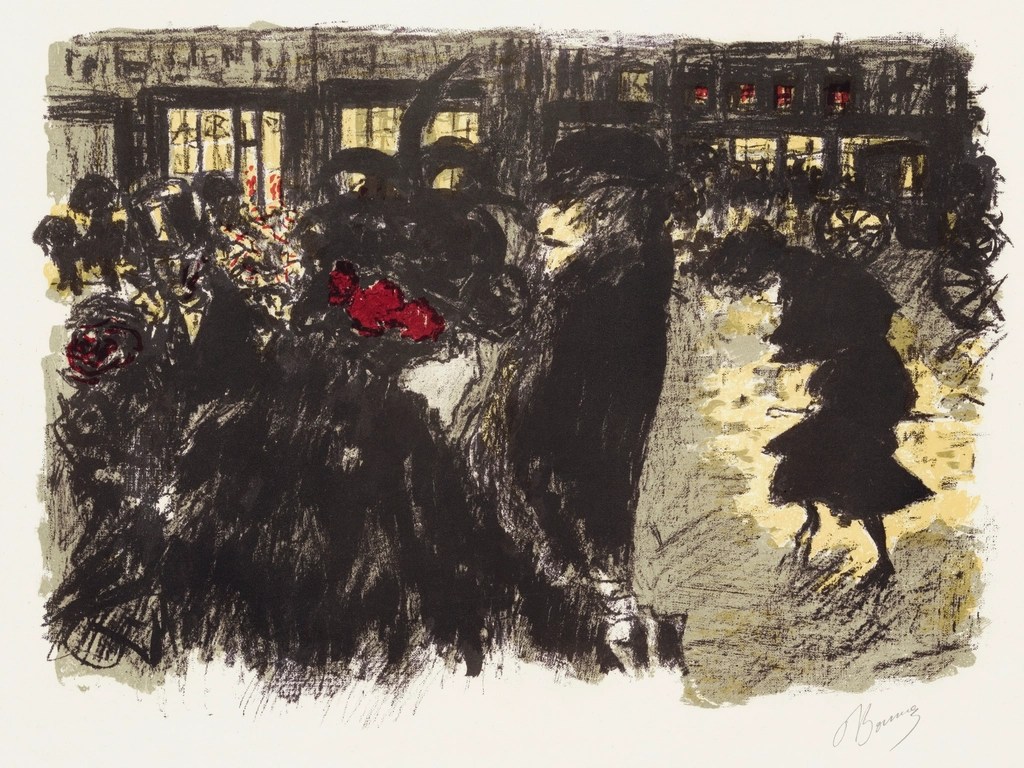
Cover photo: The Square at Evening (Place le soir) by Pierre Bonnard


 Kendall Beaver
Thank you for sharing. I will read it when I can put my feet up with a glass of vino and travel with your story.

>
LikeLike
Haha!. It’s the only way to read it. Thanks DY. 😉
LikeLike
Can’t wait for part II. Great story.
Tammy
LikeLike
Hey thanks, Tammy! 😉
LikeLike